Looking for more?
Explore our gallery for thousands of high-quality mehndi designs and inspirations.
View Full GalleryArabic vs Indian Mehndi Designs: Key Differences
Arabic and Indian mehndi are two of the most loved henna traditions in the world — and they look very different once you know what to look for. One uses bold, flowing lines and wide-open spaces, while the other fills the hand with fine, detailed work from wrist to fingertip. This guide compares the two styles side by side, so you can recognise each one at a glance and choose the style that suits your occasion, your outfit and the time you have.
Both styles use the same natural henna paste, made from the leaves of the henna plant, and both stain the skin in shades of orange-brown. The difference is not the paste — it is the design. Arabic mehndi grew out of the henna traditions of the Middle East and North Africa, where artists favoured large, graceful motifs and plenty of bare skin. Indian mehndi developed in South Asia, where bridal and festival designs became increasingly fine, dense and symbolic over the centuries. Understanding that history makes the visual differences easy to remember.
Arabic Mehndi: Bold Lines and Open Space
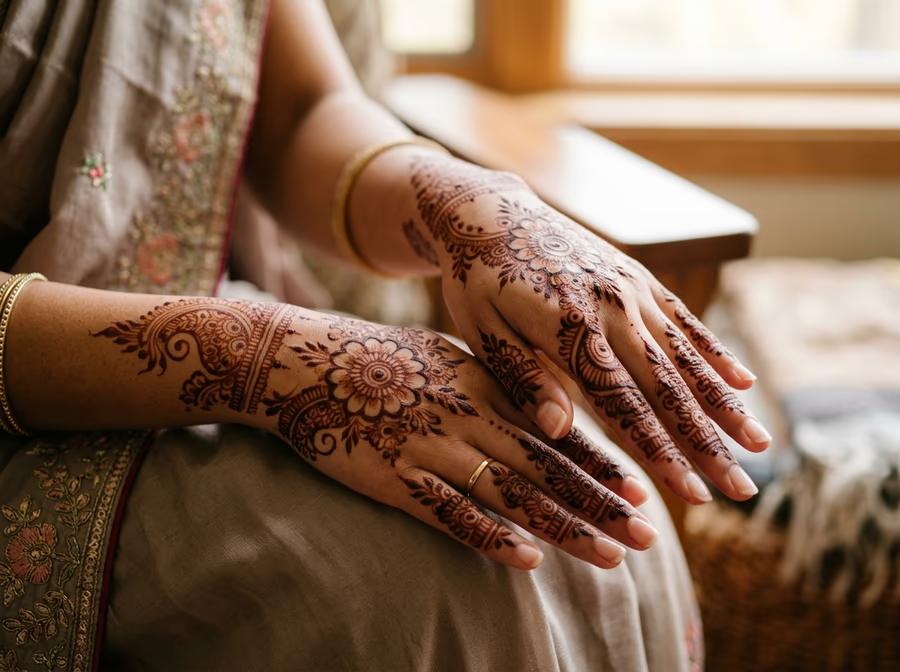
Arabic mehndi is easy to recognise. Its lines are thick and confident, its flowers are large, and much of the skin is left bare, so each motif stands out clearly. Typical Arabic mehndi designs include trailing vines that flow across the back of the hand, large paisleys, bold floral clusters, leaves, and sweeping diagonal bands that run from the wrist toward the fingers. The designs rarely cover the whole hand. Instead, they create a sense of movement, with one flowing element leading the eye to the next.
- Thick, bold lines that are easy to follow with the eye
- Large flowers, paisleys and floral clusters as the main motifs
- Trailing vines and flowing diagonal bands across the hand
- Lots of empty skin, known as negative space, between motifs
- Designs that usually cover the back of the hand rather than the palm
Because the work is less dense, Arabic mehndi is usually quicker to apply than full Indian bridal mehndi — often around half an hour to an hour for a single hand, depending on the design. That makes it a good choice when time is short, or when you want a beautiful design that still looks light and modern.
Indian Mehndi: Dense, Detailed and Traditional
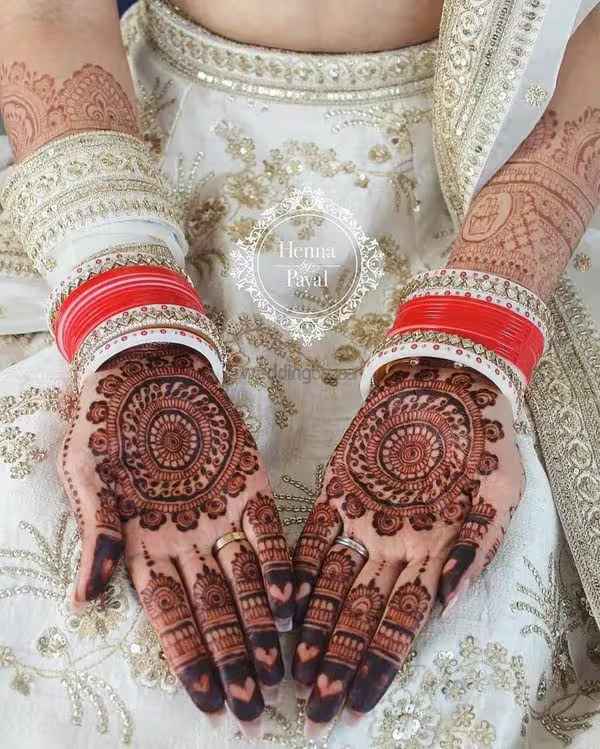
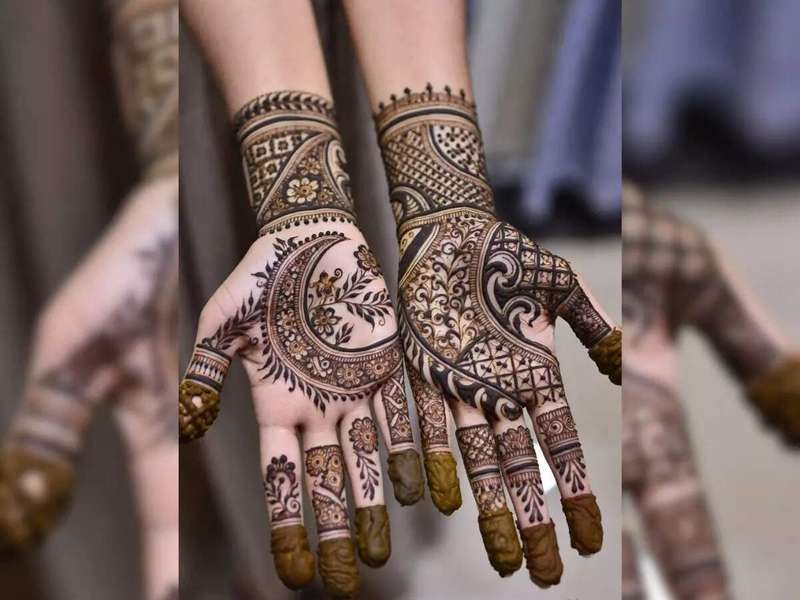
Indian mehndi is the opposite in spirit: it fills the space. A traditional Indian mehndi design covers the palm and the back of the hand, often running from the fingertips all the way to the forearm, with very little bare skin showing. The line work is fine and delicate, and the patterns are built up from small, repeated elements — tiny flowers, paisleys, dots, checks, lattice work and bands of fine shading. Look closely at a single palm and you can find dozens of small motifs woven into one continuous design.
- Fine, delicate line work with intricate detail
- Dense, full coverage from the fingertips to the wrist or forearm
- Paisleys, peacocks, lotus flowers and mango motifs
- Detailed patterns on every finger and fingertip
- Repeated small elements such as dots, checks and lattice work
For brides, Indian mehndi is the classic choice. A full bridal design can take several hours to apply and usually covers both hands, and often the feet as well. The density of the work is part of its meaning: in many families, an elaborate design and a deep, even stain are seen as part of the wedding celebration itself. Even away from weddings, a fuller Indian design suits festive occasions where the mehndi is meant to be noticed.
Key Differences at a Glance
If you are still unsure which style you are looking at, compare these points:
- Coverage: Arabic mehndi leaves most of the skin bare; Indian mehndi fills the hand almost completely.
- Line work: Arabic designs use thick, bold lines; Indian designs use fine, delicate lines.
- Motifs: Arabic designs favour large flowers, vines and paisleys; Indian designs use small, repeated motifs such as dots, lattice work, peacocks and lotus flowers.
- Space: Arabic designs use open, empty space as part of the look; Indian designs layer pattern upon pattern.
- Time: Arabic designs are usually quicker to apply; detailed Indian designs, especially bridal ones, take much longer.
- Feel: Arabic mehndi looks modern and airy; Indian mehndi looks traditional and rich.
Which Style Lasts Longer?
Neither style lasts longer by design. How long henna lasts depends mainly on the quality of the paste, how long it is left on the skin, and how the stain is cared for afterwards. The colour deepens over the first day or two, then gradually fades over one to three weeks. So if longevity matters to you, focus on good paste and careful aftercare rather than on the style of the design. Our guide to mehndi aftercare explains how to help your stain develop as dark as possible and last as long as it can.
Which Style Is Right for You?
There is no single right answer — it depends on the occasion, your outfit and how much time you have. Use these pointers as a starting point:
- Choose Arabic mehndi if you like bold, modern designs, you have limited time, or you want a lighter look for Eid or a party.
- Choose Indian mehndi if you love fine detail, you are attending a wedding or festival, or you want full coverage and have time for a longer application.
- Choose a fusion design if you like both styles and want bold Arabic shapes filled with fine Indian detail.
If you are still deciding, our guide on choosing the perfect bridal mehndi design and our simple mehndi designs for beginners can help you narrow it down by occasion and skill level.
Can You Mix Arabic and Indian Mehndi?
Yes — and many artists do. Fusion, or Indo-Arabic, mehndi uses bold Arabic-style flowers and vines as the main shapes, with fine Indian-style detail filling the spaces between them. The result keeps the airy feel of Arabic mehndi while adding some of the richness of Indian work. Ask your artist to show you examples of fusion work first, so you can agree on how much detail you want before the paste is applied.
Frequently Asked Questions
What is the main difference between Arabic and Indian mehndi?
The main difference is density. Arabic mehndi uses thick, bold lines and leaves much of the skin bare, while Indian mehndi uses fine, delicate lines and fills the hand almost completely with detailed patterns.
Which is easier for beginners, Arabic or Indian mehndi?
Arabic mehndi is usually easier for beginners, because its bold lines and open spaces are more forgiving than the fine, dense detail of Indian designs. If you are just starting out, begin with a simple Arabic-style vine or floral pattern and practise the basic strokes first.
Which style takes longer to apply?
Detailed Indian designs take longer, especially bridal designs, which can take several hours. Arabic designs are usually quicker because they use fewer, larger motifs and leave more skin uncovered.
Which mehndi style is best for a bride?
It depends on the bride. Indian bridal mehndi is the traditional choice for many South Asian weddings, with full coverage of the hands and often the feet. Some modern brides prefer Arabic or fusion designs for a lighter, more modern look. The right choice is the one that matches the bride's outfit, the wedding style and her own taste.
Final Thoughts
Arabic and Indian mehndi come from different traditions, but neither one is better than the other — they simply suit different tastes and different occasions. Once you can tell them apart, you will know exactly what to ask for, whether you want the bold flow of an Arabic design, the rich detail of an Indian one, or a little of both.
Explore More Mehndi Designs
Mehndi Design Henna Editorial Team
Henna Art & Cultural SpecialistsOur dedicated team of professional henna artists, cultural researchers, and beauty enthusiasts curate comprehensive guides, traditional patterns, and modern mehndi trends from around the world.
Browse Related Mehndi Designs
Read Next
25 Asian Henna Designs: Beautiful Ideas for Weddings, Festivals & Celebrations
Explore 25 beautiful Asian henna designs inspired by South Asian, Middle Eastern and modern styles. Find elegant ideas for weddings, festivals and special occasions.
Indian Mehndi Styles: Traditional Rajasthani, Mughal and Bridal Designs
Explore the rich diversity of Indian mehndi styles including Rajasthani, Mughal, South Indian and bridal patterns with expert tips and cultural insights.
Arabic Mehndi Designs: Bold Vines, Big Flowers and Open Space
Arabic mehndi explained: long vine patterns, heavy shading, Gulf and Levantine styles, and the flowers you'll see most often.